
The state government, however, maintained it has no intimation so far from the central government or the governor's office regarding their "observations" on certain provisions in the Bill.

Congress MP Mohammad Jawed and AIMIM president Asaduddin Owaisi have challenged the validity of the Waqf (Amendment) Bill, 2025 in the Supreme Court, arguing that it violates constitutional provisions. The petitions claim the bill imposes arbitrary restrictions on Waqf properties and their management, undermining the religious autonomy of the Muslim community. They also allege that the bill discriminates against Muslims by imposing restrictions not present in the governance of other religious endowments. The bill was passed in the Rajya Sabha and Lok Sabha, with the petitioners arguing that it introduces limitations on the creation of Waqfs based on the duration of one's religious practice, mandates inclusion of non-Muslim members in Waqf administrative bodies, and shifts key administrative functions to government officials, thereby diluting the autonomy of Waqf management.

The ruling Bharatiya Janata Party on Thursday took a major step to implement its key plank of "one nation, one election" as the Union Cabinet headed by Prime Minister Narendra Modi approved the constitutional amendment bill to roll out the concept of simultaneous Lok Sabha and state assembly polls, sources said.
'It is not as if Hindus are not being touched at all, and only Muslims are.'

The Centre's move on Chandigarh has raised the hackles of various parties in Punjab, with Aam Aadmi Party national convener Arvind Kejriwal terming it as a "direct attack" on Punjab's identity and constitutional rights.

Uttar Pradesh Chief Minister Yogi Adityanath on Sunday condemned the violence in West Bengal's Murshidabad district following the passage of the Waqf (Amendment) Bill, accusing the opposition of instigating the violence. He also criticized the opposition for their alleged silence over the persecution of Hindus in Bangladesh and emphasized the BJP's commitment to protecting Hindus.

Union Law Minister Arjun Ram Meghwal on Wednesday moved the women's reservation bill for passage in the Lok Sabha, saying it is a very important bill and urging members to pass it with unanimity.

Hours after the Waqf (Amendment) Bill was passed in Parliament, 50 individuals embroiled in land disputes in Kerala's Munambam joined the BJP, hoping for a resolution to their claims. The residents, who have been protesting for 174 days, allege that the Waqf Board is claiming ownership of their properties. BJP leader Rajeev Chandrasekhar assured them of the party's support and a meeting with Prime Minister Narendra Modi to express gratitude. The BJP capitalized on the Catholic Church's support for the legislation, accusing the Congress and the Left of appeasement politics. The opposition, however, questioned the impact of the bill on the Munambam issue.

The passing of bills without Parliament, including the treasury benches, having any real understanding of what they contained through any rigorous process has accelerated through the Modi era, points out Aakar Patel.

The Assam assembly on Thursday passed a bill to ban polygamy, making it an offence which may lead to a maximum of 10 years of imprisonment, barring some exceptions.

Introducing the bill, Rijiju said the consultation process of the Joint Parliamentary Committee (JPC) was the largest ever exercise carried out by a parliamentary panel in India's democratic history.
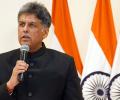
Congress MP Manish Tewari has introduced a bill in Lok Sabha that seeks to allow parliamentarians to take an independent line in voting on bills and motions other than those affecting the government's stability in a bid to free them from "whip-driven tyranny" and promote "good lawmaking".
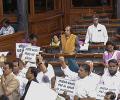
The monsoon session of Parliament which saw many disruptions since it began on July 20 over the Manipur violence issue, is set to become more turbulent with the government likely to introduce a bill in the Lok Sabha to replace the Delhi services ordinance.

The Union Cabinet has reportedly approved the Kerala government's proposal to officially change the state's name to Keralam, following a resolution passed by the Kerala Assembly.

However, Rajya Sabha being a continuing chamber is not subject to dissolution, and bills introduced and pending in this House remain on the live register, unless withdrawn by the government.

Besides the bills, the government has listed the first batch of supplementary demands for grants for 2023-24 for presentation, discussion and voting during the session.

The government is likely to push for the passage of the National Sports Governance Bill in the Lok Sabha, despite ongoing parliamentary disruptions due to opposition protests over the Special Intensive Revision (SIR) of electoral rolls. Other bills are also listed for consideration.

The parliamentary panel's meetings have become a virtual battleground between the opposition and the ruling party members, who have been vociferously debating the changes to the Waqf Bill proposed by the government.

Six bills, including the one to amend the Jammu and Kashmir Reorganisation Act, were introduced in the Lok Sabha on Wednesday amid protests by opposition members over the violence in Manipur.

The Centre has also listed 24 bills, including the Cantonment Bill, the Multi-State Cooperative Societies (Amendment) Bill and the Insolvency and Bankruptcy Code (Amendment) Bill.
A 39-member parliamentary panel has been constituted to examine the two bills proposing simultaneous elections to the Lok Sabha and state assemblies. The panel, chaired by BJP leader Bhratruhari Mahtab, will include prominent members from various political parties, including the BJP, Congress, SP, TMC, and DMK. The panel is expected to submit its report to the Lok Sabha by the first day of the last week of the next session. The government has decided to increase the committee's strength to include more political parties, highlighting the significance of this proposal to reform the election process in India.

The Lok Sabha witnessed chaotic scenes as opposition members protested the introduction of three draft laws, leading to torn bills, sloganeering, and adjournments.

The Lok Sabha on Tuesday passed the Constitution amendment bill to restore the power of states to make their own OBC lists after a thaw in the logjam as Opposition parties backed the legislation but demanded the removal of the 50 per cent cap on reservation, with many of them also calling for a caste-based census.

Ministers arrested post-2014 who, if the 130 Constitutional Amendment had been in effect, would have been unseated from office.

Both factions of the Jamiat Ulema-e-Hind (Arshad Madani and Mahmood Madani) slammed the Bill and expressed grave concerns over the proposed legislation.

The Supreme Court has ruled that a Governor cannot send bills to the President for consideration if the state assembly has already cleared them for a second time. The court was questioning the Centre over the powers of the Governor when it comes to granting assent to bills.

The government may have to move 18 amendments to the Constitution to implement the concept of simultaneous elections as recommended by a high-level committee chaired by former president Ram Nath Kovind.

Keen to scrap the collegium system, government on Monday introduced a Constitution Amendment Bill in Lok Sabha to establish a six-member body for appointment of judges to the Supreme Court and the high courts.

Chronology of events in which the Supreme Court on Monday delivered judgment on 10 per cent reservation to people belonging to the economically weaker sections (EWS) in admissions and government jobs.
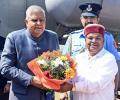
Karnataka Governor Thaawarchand Gehlot has reserved the Bill pertaining to four percent reservation for Muslims in government contracts for the President's assent, citing constitutional concerns. The Bill, which has been a subject of controversy in Karnataka, was passed by both houses of the state legislature amid protests from the opposition BJP. The Governor's decision to reserve the Bill highlights the ongoing debate over the constitutionality of religious-based reservations in India.

Patel emphasised that one of the most important features of the bill is the establishment of a dedicated tribunal for resolving disputes, reducing the burden on the judiciary and ensuring quicker justice.
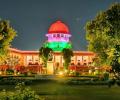
The Centre told the Supreme Court that governors are not indefinitely sitting on bills passed by state legislatures, and that barring a few exceptions, most have acted in a way which the apex court would have perhaps desired. Solicitor General Tushar Mehta argued that a Governor is "not a rubber stamp" and has a duty to preserve, protect, and defend the Constitution.

President Asif Ali Zardari signed into law a landmark constitutional amendment bill on Monday that will strip him of his sweeping powers, saying it would help prevent the emergence of dictatorships in Pakistan.
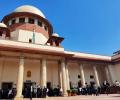
The National Judicial Commission Bill, 2022, was introduced after the majority of voice votes were in its favour.

The Supreme Court is scheduled to pronounce interim orders on key issues related to the Waqf (Amendment) Act, 2025, including the power to denotify waqf properties.
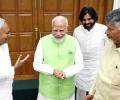
It also cautioned that if the legislation is passed, the "two crutches" on which the Bharatiya Janata Party-led government is running at the Centre would not be able to escape responsibility.

FM said a Constitution Amendment Bill for introduction of GST will be passed soon.

Opposition parties Nationalist Congress Party and Samajwadi Party on Wednesday demanded reservation for OBCs in the women's reservation bill and questioned the reason for calling a special session when the bill cannot be implemented before census and delimitation.

The Web portal of the Organiser, the RSS mouthpiece, published an article (withdrawn later) that the Christian community holds many acres of land, far more than Waqf property.'

Kerala's voters are sophisticated, educated, and unforgiving. They have once again made it clear that no government is entitled to remain in power. The Congress would do well to remember this, points out Ramesh Menon.
